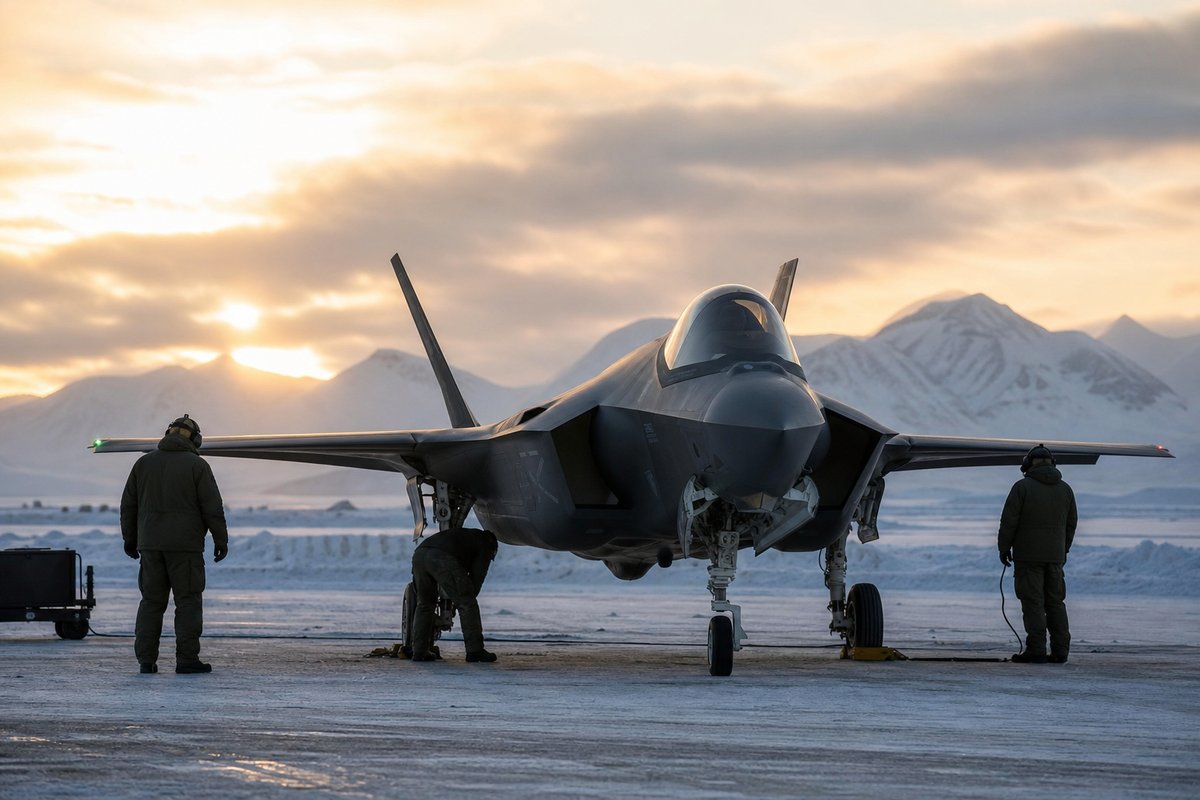
Norway reached a notable milestone in April 2025 when it received the final two F-35As in its order, completing its full program of record. According to the report, the Royal Norwegian Air Force now operates 52 F-35As, making Norway the first country to fully fulfill its planned purchase of the Lockheed Martin fighter.
That achievement matters not only for Norway, but for the wider F-35 program. The aircraft has replaced the country’s aging F-16 fleet, with the retired jets largely passed on to Romania as it modernized from older MiG-21s. A smaller number of Norwegian F-16s were also made available to Ukraine, including some used for spare parts. Lockheed Martin has said the F-35As will support NATO missions and help defend the High North, a region that remains central to Norway’s security planning.
Why Norway’s milestone is not the whole story
Although Norway was first to complete its official order, the report notes that the title can be misleading when compared with other NATO operators. A program of record is an approved and funded acquisition plan, but in practice these plans can change over time. The United Kingdom is a clear example: it originally planned to buy 150 F-35s, later reduced that target to 138, briefly considered cutting it further, and has so far received 48 aircraft. Its next order is expected to cover 27 more jets, including 15 F-35Bs and 12 F-35As.
Australia is also highlighted as a major operator, and Norway’s place in the F-35 pecking order is expected to shift as more aircraft are delivered elsewhere. Norway currently sits alongside Japan as the second-largest F-35 operator outside the United States, with Australia ahead of both. However, the Netherlands is closing in, and other countries including Israel, the UK, Italy, and South Korea are expected to operate larger fleets than Norway in the 2030s. The U.S. Air Force remains by far the largest customer, with plans that could account for roughly half of all F-35s eventually produced.
The report also places Norway’s procurement choices in a broader European context. Smaller air forces often select a single frontline fighter type, while larger ones may split fleets between two aircraft families. That helps explain the ongoing debates in countries such as the UK, Italy, and Germany over how many F-35s to buy alongside other fighter programs.
Source: simpleflying.com