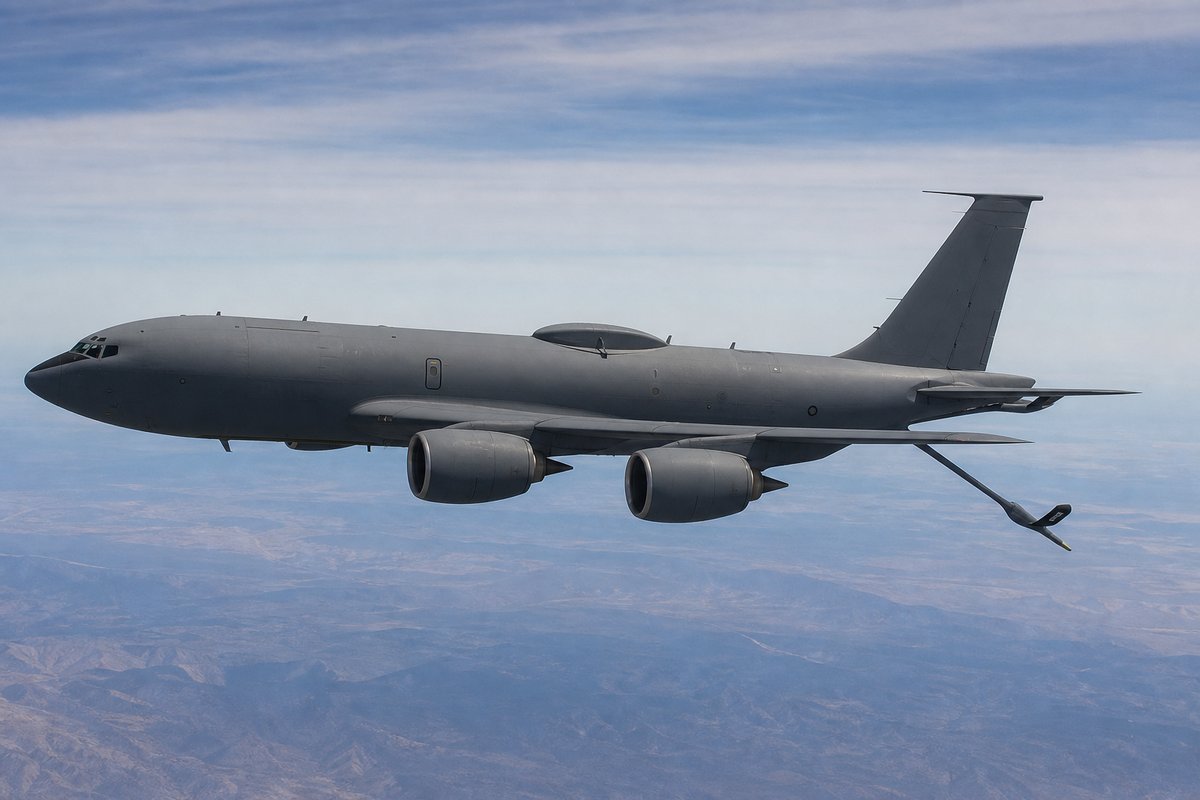
A KC-135R Stratotanker seen at RAF Mildenhall in early June 2026 appeared with a new trapezoid-shaped antenna on the upper rear fuselage, and the aircraft’s markings had been removed under operational security procedures. Based on its shape and size, analysts cited in the report said the hardware closely resembles a Starlink-style high-bandwidth satellite terminal, likely tied to Starshield, SpaceX’s government-focused and encrypted satellite communications system.
The antenna is not being interpreted as a simple crew internet upgrade. Instead, the Air Force appears to be using the KC-135 as part of a larger communications architecture that supports combat operations. In its FY2027 budget request, the service describes the effort as “MAF Connectivity,” aimed at helping the tanker connect to the broader joint force in order to close kill chains and logistics chains. The same documents also refer to a “Hybrid SATCOM capability,” which would let aircraft switch between government and commercial satellite constellations using multi-band, multi-orbit terminals.
A relay role for the tanker fleet
According to the report, the first publicly visible evidence of this upgrade is the antenna seen on the KC-135, although a similar aircraft may have been photographed online in April 2026. The program itself has been developing for years through Air Force Research Laboratory work known as Global Lightning, which has been active since 2018, and through a six-month Quick Reaction Capability contract with Sierra Nevada Corporation. The budget documents also mention possible elements such as intelligent gateways, antennas, radios, software updates, crew displays, and multiple aperture array housings.
The reason the KC-135 matters is its scale and longevity. The tanker fleet is expected to remain in frontline service well into the 2040s, with some aircraft planned to fly until 2050, making it the Air Force’s most numerous platform for airborne connectivity upgrades. That matters especially for aircraft such as the B-21 Raider, which is designed to limit its own electronic emissions in contested airspace. In that setup, the bomber can communicate briefly and locally with the tanker, while the KC-135 relays the data onward through the satellite network, acting as a communications proxy farther from the threat environment.
Source: simpleflying.com