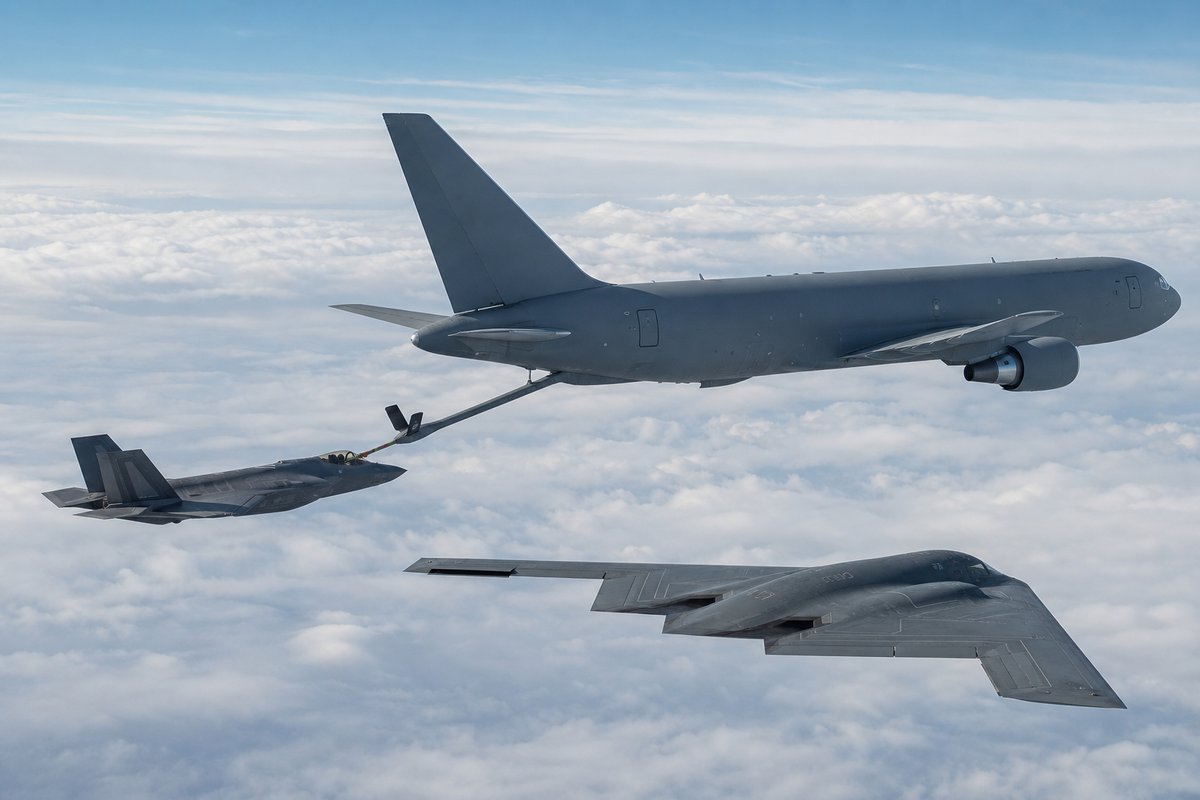
The Boeing KC-46 Pegasus has become a major part of the U.S. Air Force’s tanker fleet, with more than 100 aircraft already in service and a total fleet expected to rise beyond 260. It has supported missions in Europe, the Middle East, and the Indo-Pacific, but the tanker still cannot safely refuel every aircraft it was designed to serve. According to the report, the remaining limitations come from two separate issues: one tied to the refueling boom itself, and another linked to the aircraft’s remote vision system.
One of the clearest examples is the A-10 Thunderbolt II. The aircraft can connect to the KC-46 during testing, but the tanker’s original boom actuator requires about 1,400 pounds of axial force to stay compressed and maintain contact. The A-10, by comparison, can generate far less forward pressure during refueling, especially when loaded. That leaves the aircraft unable to sustain a stable connection with the KC-46 in operational use. Older tankers such as the KC-135 avoid this problem because their boom systems offer more flexibility.
The Air Force plans to address the issue through the Boom Telescope Actuator Redesign, or BTAR, but that fix is not expected to begin entering service until late fiscal year 2027, with further improvements extending into 2028. In the meantime, the service has turned to a workaround: a probe-and-drogue adapter for the A-10, first used successfully on April 2, 2026, with a C-130-based tanker. The adapter allows the aircraft to refuel from HC-130J and MC-130J tankers, but it does not solve the KC-46 compatibility problem.
A second limitation affects the Lockheed Martin F-22 Raptor and Northrop Grumman B-2 Spirit bomber. For these aircraft, the concern is not mechanical force but the KC-46’s Remote Vision System, which replaces the traditional rear window used by boom operators. The report says the system can create refueling contacts that risk damaging the radar-absorbent skin on two of the Air Force’s most sensitive aircraft. As a result, the KC-46 remains an advanced tanker with broad utility, but one that still cannot safely support every aircraft in the USAF inventory.
Source: simpleflying.com