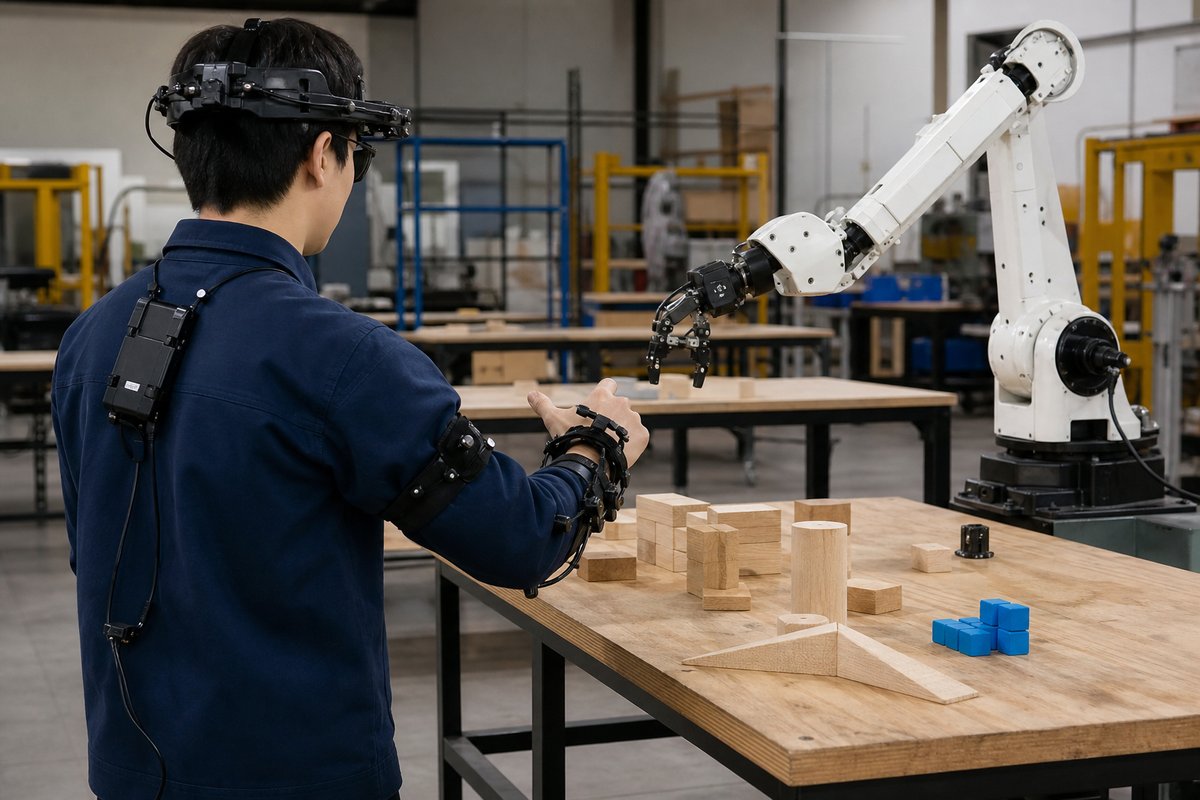
In a warehouse in San Leandro, California, Encord is testing a new approach to one of robotics’ biggest problems: the shortage of high-quality physical-world training data. The company, which already helps customers annotate and evaluate machine-vision data, is now building its own data-creation operation for humanoid and warehouse robots. Its latest experiment adds a brain-wave headset to a Jenga-style task, with the goal of seeing whether signals tied to intent, error and surprise can make robot training data more useful.
The headset was developed by Zander Labs, a German neuroscience startup, and the current project is only a trial. Encord plans to build a small brain-wave-tagged dataset, test it inside customer robotics models and then decide whether the results justify expanding the effort. According to the report, Zander’s scientists believe brain activity measured during a task could help identify when a model needs to switch to a more capable, higher-effort system. Encord’s head of robot learning, Vineeth Velmurugan, described the effort as the “bleeding edge” of solving the robotics data bottleneck.
Why data, not model design, is becoming the bottleneck
Velmurugan, who previously worked at OpenAI’s robot lab and Berkshire Grey, said the core issue is that the data robotics companies need often simply does not exist. As end-to-end learning becomes more common in robotic manipulation, companies are finding they cannot rely on managing existing datasets alone and must generate their own. The challenge is especially acute because training from video can help, but it does not match the fidelity of real-world interaction, and gathering physical-world data at scale is difficult. Velmurugan estimated that a dataset roughly five times larger than YouTube’s video corpus may be needed to push robotics past this stage.
To build that kind of data, Encord is using two main sources: egocentric video from workers wearing cameras and remotely operated robots. At its San Leandro site, the company is also experimenting with new inputs such as forearm sensors that detect electrical signals in muscles. Those sensors are intended to help reconstruct the position of a human hand in 3D, even when video does not capture the full hand. Encord also labels its datasets with detailed physical descriptions, such as a hand tightening a bolt, which it says can be far more valuable than lower-quality first-person video for specific tasks. The company is already collecting data around tasks such as pouring coffee, stacking poker chips and plugging ethernet cables, reflecting the growing commercial demand for robot training data as a business in its own right.
Source: techcrunch.com