DJI’s Osmo Pocket 4P has finally arrived globally after a drawn-out rollout that included early leaks, a teaser, an initial China launch, and months of uncertainty for other markets. The camera is being positioned as a major step up for creators and vloggers, but its availability in the US is complicated by government restrictions on DJI products, which prevent retailers there from officially selling it. According to the report, it can still be found through unofficial channels, though that does not change the broader access issue.
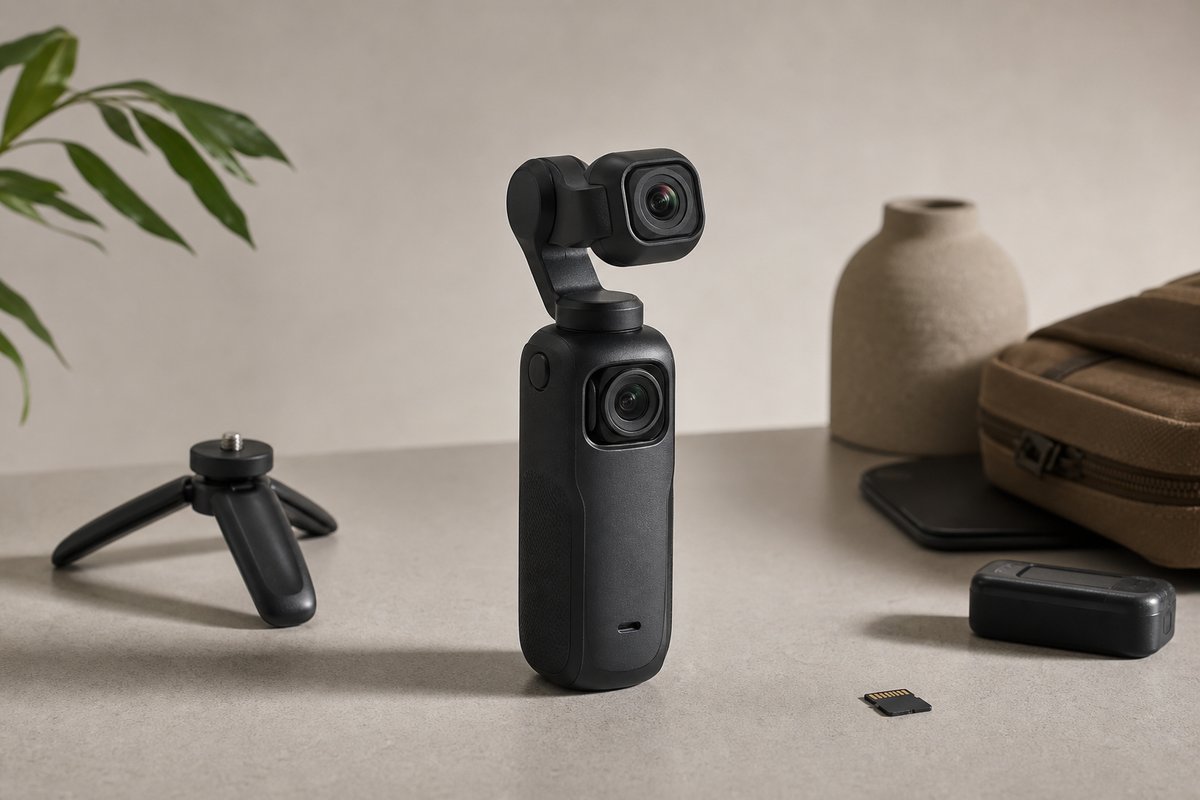
The biggest change is the move to a dual-lens gimbal system. The main camera uses a 20mm-equivalent f/2.0 wide-angle lens with a 1-inch sensor, while the second lens is a 60mm-equivalent f/1.8 medium telephoto paired with a 1/1.28-inch sensor. Together, they enable true 3x optical zoom, up to 6x in-sensor zoom, and as much as 12x digital zoom. The camera records up to 4K video rather than 6K, but it does support slow motion at up to 240 fps and can capture 37-megapixel still images.
Image quality and controls
DJI also highlighted a claimed 17 stops of dynamic range, a figure that would place the Pocket 4P in unusually strong territory for a compact camera aimed at handheld content creation. The report notes, however, that this full range is limited to the primary camera and only when using the 10-bit D-Log 2 profile. The body itself remains the same as the standard Pocket 4, with a 2-inch OLED display, two physical buttons, a clickable joystick, 103GB of internal storage, a microSD slot, and an expansion port for accessories such as DJI’s magnetic fill light. Because the design is unchanged, it also works with a broad range of third-party add-ons.
The optical zoom is presented as the standout feature. The 60mm lens gives the camera more flexibility for portraits, product shots, and solo filming, while also helping subject separation through a shallower depth of field. The report says ActiveTrack still functions while zoomed in, making framing easier for one-person shoots. While the switch between lenses is not perfectly smooth and can still cause minor changes in exposure, color, or framing around the 3x point, the overall zoom performance was described as unusually strong, even when pushed beyond optical range.
Source: engadget.com